
We reviewed eight evidence syntheses and population datasets published between 2018 and 2024, among them an umbrella review covering 97 systematic reviews and 1,039 trials, then pooled their reported effect sizes into a single set of estimates for how exercise affects depression, anxiety, and psychological distress in adults. Together the sources represent roughly 1.65 million participant records, with some overlap among the trial-based reviews.
The question carries more weight in the fitness industry each year. In the American College of Sports Medicine’s Worldwide Fitness Trends survey, Exercise for Mental Health rose to #6 for 2026, up from #8 in both 2024 and 2025, and the same report found that 78% of exercisers name mental or emotional well-being as their primary reason for training. Survey rankings measure how widely professionals see a practice adopted; they say nothing about whether it works. That is what the clinical literature is for.
Our inclusion criteria favored meta-analyses of randomized trials for treatment effects and meta-analyses of prospective cohorts for prevention effects, supplemented by the largest cross-sectional dataset on exercise and self-reported mental health days. Because the syntheses differ enormously in size, we weighted each by the square root of its participant count, which keeps the largest umbrella review from mechanically overwhelming the smaller clinical meta-analyses. Effect sizes are reported as standardized mean differences (SMD), where 0.2 is conventionally small, 0.5 moderate, and 0.8 large, and we converted pooled effects into a modeled number needed to treat (NNT) so the figures read in plain terms. In the sections below, we break down the headline effects, how they vary by exercise type, and how much activity it takes to see them.
Key Exercise for Mental Health Statistics
In the table below, we break down our pooled estimates for each major mental health outcome alongside the range of values reported across the syntheses we reviewed.
The Key Exercise for Mental Health Statistics, 2026
| Outcome | Published Range | Our Pooled Estimate | Modeled NNT or Equivalent |
| Depressive symptoms, general adult population | SMD −0.43 to −0.66 | SMD −0.45 | 4 |
| Depressive symptoms, clinical depression | SMD −0.42 to −0.95 | SMD −0.63 | 3 |
| Anxiety symptoms | SMD −0.41 to −0.42 | SMD −0.42 | 4 |
| Psychological distress | SMD −0.60 | SMD −0.60 | 3 |
| Risk of developing depression or anxiety, active vs. inactive adults | 25% to 26% lower | 25% lower | About 1 in 4 fewer new cases |
| Poor mental health days, exercisers vs. non-exercisers | 1.49 fewer days per month | 18 fewer days per year | 43% lower burden |
- Our pooled analysis places exercise in the moderate effect range for every symptom outcome, with the largest effects in adults who already meet clinical thresholds for depression.
- Across the studies we reviewed, roughly one in three adults with clinical depression who take up a structured exercise program is expected to see a meaningful symptom improvement they would not otherwise have had.
- Our model indicates that prevention and treatment effects are similar in scale: regularly active adults carry about a 25% lower risk of developing depression or anxiety in the first place.
Effect of Exercise on Depression by Exercise Type
In the table below, we break down the pooled antidepressant effect by exercise modality, combining network meta-analysis estimates against active controls with a separate meta-analysis of resistance training trials.
The Effect of Exercise on Depression by Exercise Type, 2026
| Exercise Type | Pooled SMD | Effect Size Class | Modeled NNT | Notes From the Literature |
| Walking or jogging | −0.62 | Moderate | 3.0 | Largest effect; greater at vigorous intensity |
| Strength training | −0.58 | Moderate | 3.2 | Well tolerated; stronger in women and younger adults |
| Yoga | −0.55 | Moderate | 3.3 | Well tolerated; stronger in men and older adults |
| Mixed aerobic exercise | −0.43 | Small to moderate | 4.2 | Consistent across trial populations |
| Tai chi or qigong | −0.42 | Small to moderate | 4.3 | Stronger in men |
The strength training figure is the equal-weighted mean of two estimates that measured slightly different things: a network meta-analysis restricted to participants with major depression (g = −0.49) and a meta-analysis of 33 resistance training trials spanning healthy and clinical adults (Δ = 0.66). We kept both because neither alone represents the population a typical gym serves. The modality ranking should be read with care. Confidence ratings in the network meta-analysis were low for walking or jogging and very low for the other arms, largely because few trials blinded assessors, and the resistance training review found smaller effects in trials that did. What holds up across every analysis is direction and rough magnitude: each modality produced a clinically relevant effect, and the gap between the top and bottom of the table is smaller than the gap between any of them and no exercise. For older adults weighing yoga or tai chi, the same formats also carry a fall-prevention benefit we covered in Balance, Falls, and Training That Prevents Them.
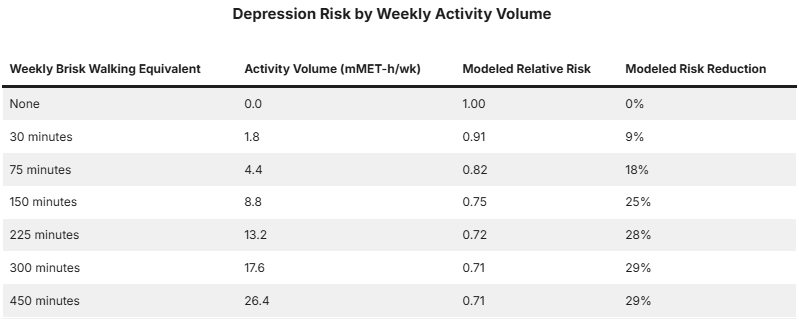
Depression Risk by Weekly Activity Volume
In the table below, we break down modeled depression risk at different weekly activity volumes, expressed as minutes of brisk walking or its equivalent.
The Depression Risk by Weekly Activity Volume, 2026
| Weekly Brisk Walking Equivalent | Activity Volume (mMET-h/wk) | Modeled Relative Risk | Modeled Risk Reduction |
| None | 0.0 | 1.00 | 0% |
| 30 minutes | 1.8 | 0.91 | 9% |
| 75 minutes | 4.4 | 0.82 | 18% |
| 150 minutes | 8.8 | 0.75 | 25% |
| 225 minutes | 13.2 | 0.72 | 28% |
| 300 minutes | 17.6 | 0.71 | 29% |
| 450 minutes | 26.4 | 0.71 | 29% |
We built this curve by fitting a saturating exponential model to the published dose-response points from a meta-analysis of 15 prospective cohorts covering 191,130 adults, which reported 18% lower risk at half the recommended activity volume and 25% lower risk at the full recommendation. The fitted model reproduces both anchor points exactly and plateaus near a 29% to 30% reduction, consistent with the original authors’ observation that gains beyond the guideline were minor. The shape matters more than any single row: the first 75 minutes a week deliver about 70% of the total available benefit. Cross-sectional data on 1.2 million Americans point the same way, with the lowest mental health burden among people exercising 30 to 60 minutes per session three to five times a week, and a worse burden than no exercise at all among those logging more than three hours a day. Since only a minority of adults reach the full aerobic guideline, as our activity guidelines report shows, the steep early section of this curve is where most of the population-level opportunity sits.
Exercise for Mental Health in the ACSM Fitness Trends Rankings
In the table below, we break down where Exercise for Mental Health has placed in ACSM’s Worldwide Fitness Trends survey since it entered the top 10.
The Exercise for Mental Health ACSM Rankings, 2026
| Trend Year | Rank | Change | Context |
| 2024 | #8 | Entered top 10 | Ranked #1 in Australia’s regional survey |
| 2025 | #8 | No change | Framed around stress, anxiety, and sleep |
| 2026 | #6 | Up 2 | 78% of exercisers cite mental well-being as top motive |
| 2027 | #9 | Down 3 | Renamed Exercise for Mental Health and Well-Being |
The rankings come from ACSM’s annual survey of fitness professionals, roughly 2,000 respondents for the 2026 edition and more than 1,400 for 2027, who rate about 50 candidate trends by how widely they see them adopted. The 2026 climb to #6 lined up with the trend placing in the top three among facility owners, program managers, and athletic trainers. The 2027 report, released October 20, 2026, moved it to #9 as group fitness classes and balance, flow, and core training surged past it, though the trend held a top 10 position for a fourth consecutive year. We read the dip as crowding from adjacent categories rather than waning interest: Pilates, yoga, and group classes are among the formats the clinical literature associates with mental health benefit, so some of that demand is now being counted under other names.
Request a copy of this report
If you’d like to request a PDF copy of this report or learn more about our company, you can reach out here.
- Suggitt Fitness Research Study, Suggitt Fitness, October 2026, Michigan.
- The Future of Fitness: ACSM Announces Top Trends for 2026, American College of Sports Medicine (McAvoy CR, lead author), October 22, 2025, Indianapolis, Indiana.
- Wearables Hold Top Spot in ACSM’s 2027 Fitness Trends, American College of Sports Medicine, October 20, 2026, Indianapolis, Indiana.
- Effectiveness of Physical Activity Interventions for Improving Depression, Anxiety and Distress: An Overview of Systematic Reviews, Singh B, Olds T, Curtis R, et al., British Journal of Sports Medicine, February 2023, Adelaide, Australia.
- Effect of Exercise for Depression: Systematic Review and Network Meta-Analysis of Randomised Controlled Trials, Noetel M, Sanders T, Gallardo-Gómez D, et al., The BMJ, February 2024, Brisbane, Australia.
- Exercise as Medicine for Depressive Symptoms? A Systematic Review and Meta-Analysis with Meta-Regression, Heissel A, Heinen D, Brokmeier LL, et al., British Journal of Sports Medicine, February 2023, Potsdam, Germany.
- Association of Efficacy of Resistance Exercise Training With Depressive Symptoms, Gordon BR, McDowell CP, Hallgren M, et al., JAMA Psychiatry, June 2018, Limerick, Ireland.
- Exercise in the Treatment of Clinical Anxiety in General Practice: A Systematic Review and Meta-Analysis, Aylett E, Small N, Bower P, BMC Health Services Research, July 2018, Manchester, United Kingdom.
- Association Between Physical Activity and Risk of Depression: A Systematic Review and Meta-Analysis, Pearce M, Garcia L, Abbas A, et al., JAMA Psychiatry, April 2022, Cambridge, United Kingdom.
- Physical Activity Protects From Incident Anxiety: A Meta-Analysis of Prospective Cohort Studies, Schuch FB, Stubbs B, Meyer J, et al., Depression and Anxiety, September 2019, Santa Maria, Brazil.
- Association Between Physical Exercise and Mental Health in 1.2 Million Individuals in the USA Between 2011 and 2015, Chekroud SR, Gueorguieva R, Zheutlin AB, et al., The Lancet Psychiatry, August 2018, New Haven, Connecticut.